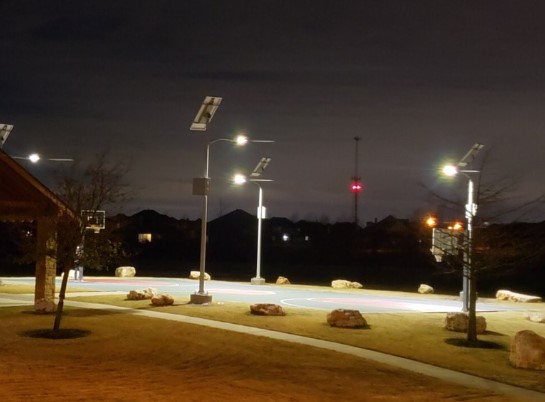
Solar Street Light Design Guidelines for Communities and Residential Areas​

Solar Street Light Design Guidelines for Communities and Residential Areas​

Table of Contents

  1. Communities and Residential Solar Street Lights Brightness and Luminous Efficacy Design
  2. Communities and Residential Solar Street Light Color Temperature and Color Rendering
  3. Communities and Residential Solar Street Light Pole and Installation Design
  4. Communities and Residential Solar System Design
  5. Residential and Communities Solar Street Light Automatic Control and Intelligence
  6. Residential and Communities Solar Street Light Costs and Return on Investment (ROI)
1. Communities and Residential Solar Street Lights Brightness and Luminous Efficacy Design.
Illuminance Standards (Lux)
  • Regular vehicle traffic (max. 40 km/h): the recommended illuminance for residential main roads is 20 lux with uniformity (Uo) ≥0.4; for Traffic areas for slow moving vehicle traffic (max. 10 km/h), e.g. bicycles & trucks, maintain illuminance of 10 lux with uniformity ≥0.4.
  • Pedestrian Activity Areas (such as squares, fitness areas): Should be elevated to 20-30 lux to ensure visual safety
Lumens and Luminous Efficacy Requirements
  • Light Source Selection: Preferably use LED light sources with luminous efficacy ≥180 lm/W. The total lumens per light should be calculated using the formula: Total Lumens = Target Illuminance (lux) × Illuminated Area (m²) ÷ Fixture Efficiency (approximately 0.6-0.8) For example, lighting a 100 m² area at 20 lux requires approximately 2500-3300 lumens fixtures.
  • Efficiency Optimization: Use reflectors or lenses to reduce light loss and improve effective light utilization above 70%.
2. Communities and Residential Solar Street Light Pole and Installation Design.
Color Temperature (CCT)
  • Safety and Comfort Balance: It is recommended to select neutral white light in the range of 3000K-5000K to avoid the cold feeling caused by high color temperatures (>6000K) while ensuring nighttime visibility
  • Eco-friendly: For areas close to nature reserves, use 2700K warm white light to reduce light pollution on wildlife.
Color Rendering Index (CRI)
  • The core areas (such as entrances, signage) require CRI ≥80 to ensure accurate color rendition; general roads can be relaxed to CRI ≥70
3. Communities and Residential Solar Street Light Pole and Installation Design.

Pole Height

  • Main Roads/Traffic Lanes: Pole height of 6-8 meters, spacing of 25-30 meters, ensuring beam coverage width ≥ road width 1.2 times.
  • Sidewalks/Small Squares: Pole height of 4-6 meters, spacing of 15-20 meters, to avoid glare interference.

Material Selection

  • Weather Resistance and Lightweight: Prefer hot-dipped galvanized steel (thickness ≥3.5mm) or aluminum alloy materials, with corrosion protection rating IP55 and above; coastal areas should use 316 stainless steel.
  • Structural Design: Conical poles withstand wind pressure ≥40m/s, foundation depth ≥1.5 meters, and ensuring stability.
4. Communities and Residential Solar System Design

Continuous Lighting Days

  • Design according to the most unfavorable weather (continuous rain), suggesting that the system storage should support 3-5 days of independent power supply. Battery capacity calculation formula:
  • Battery Capacity (Ah) = Daily Power Consumption (Wh) × Continuous Days ÷ System Voltage (V) ÷ Discharge Depth (0.7)

System Configuration Optimization

  • Photovoltaic Panel Power: Adjust according to local average daily sunlight hours. For regions with an average of 4 hours of sunlight, photovoltaic power ≥ daily power consumption of fixtures ÷ 4 ÷ 0.8 (efficiency factor).
  • MPPT Controller: Enhance solar energy conversion efficiency to over 95%.
5. Residential and Communities Solar Street Light Automatic Control and Intelligence

Control Strategy

  • Time-based Dimming: Full power operation during peak hours, reducing to 50% illuminance after midnight, saving 30%-40% energy.
  • Sensor Control: Achieve “lights on when people come, lights off when people leave” through microwave/infrared sensors, suitable for low-traffic areas.

Remote Monitoring

  • Integrate IoT modules for real-time monitoring of system status (battery voltage, light output), automatic fault alarms, reducing operating and maintenance costs.
6. Residential and Communities Solar Street Light Costs and Return on Investment (ROI)

Initial Cost

  • Single lamp system (including photovoltaic panels, batteries, fixtures): approximately R8500, varying with power and materials.

Payback Period

  • Compared to traditional grid power, annual electricity savings of approximately R1600-R3000/lamp, combined with lower maintenance costs (no electricity costs, fewer repairs), resulting in an ROI period of about 5-8 years.

Request a Call Back

Interested in upgrading your city’s lighting? Request a Call Back today and let our experts guide you to the perfect solar streetlight solution.

Phone :
+27 79 805 1231
Email :
sales@citylighting.co.za